The Great Nest by the Western Ocean
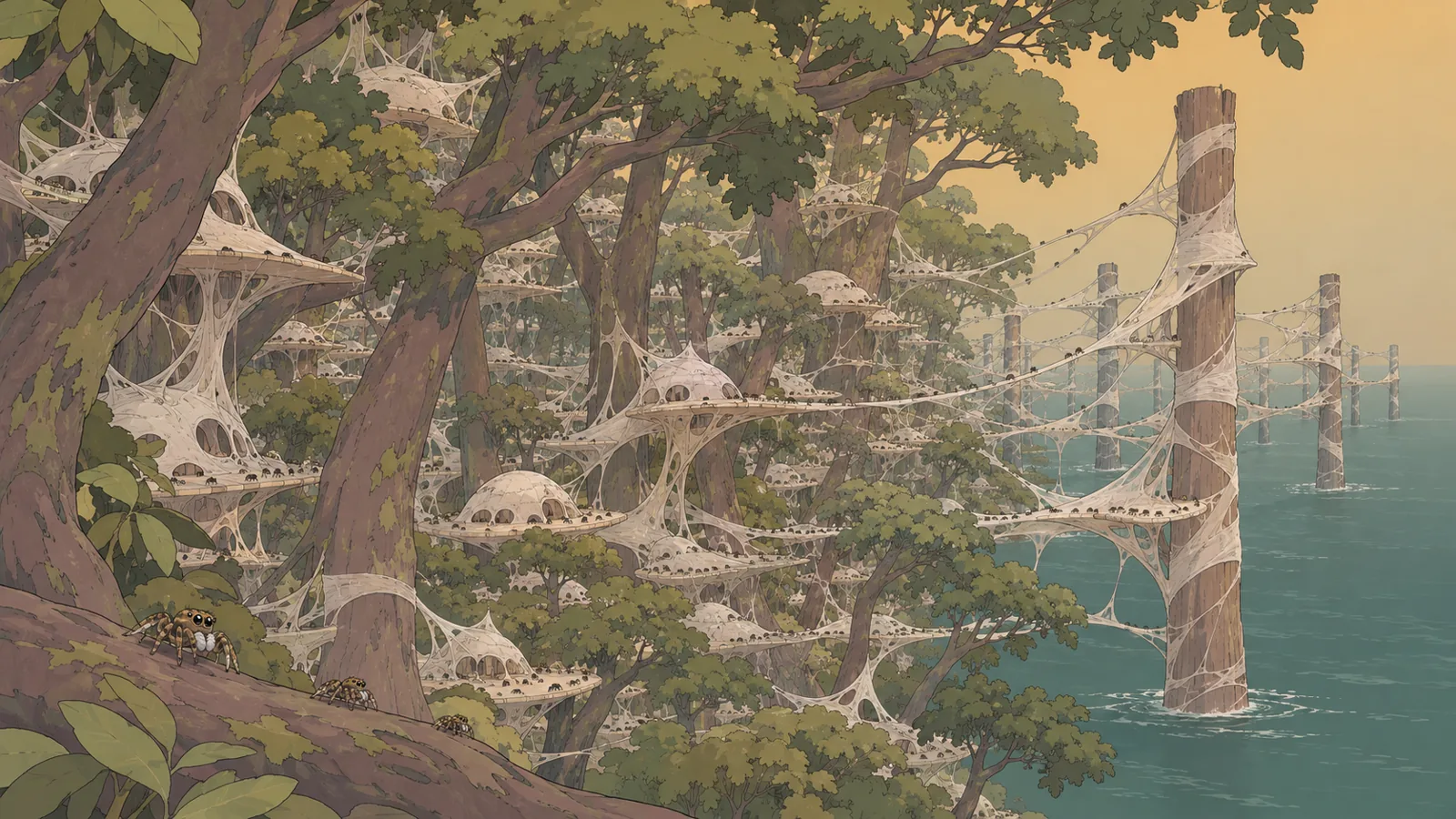
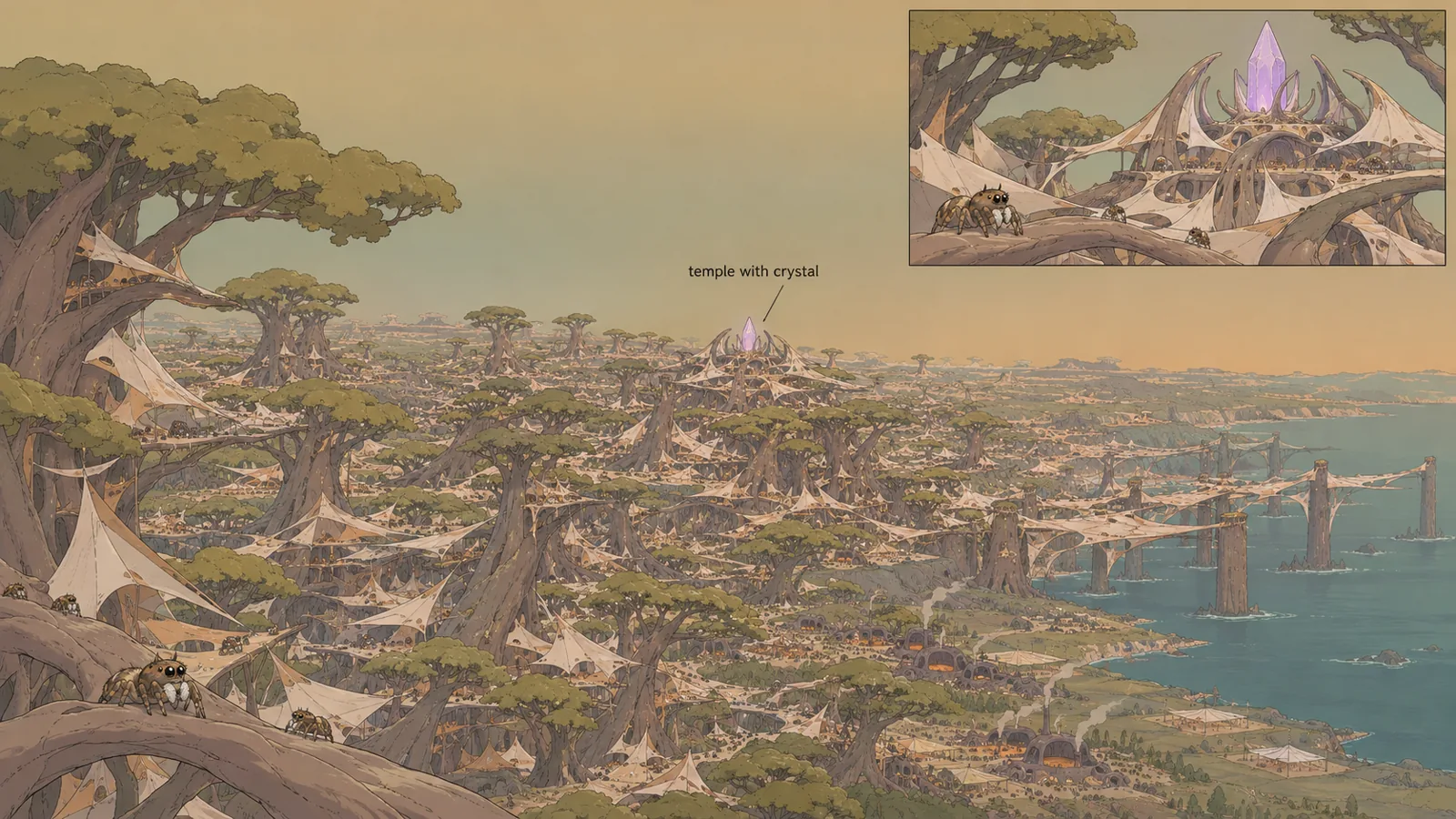
The Great Nest by the Western Ocean is the largest city of Portia’s kind. It grows from a settlement of several hundred spiders into a metropolis with hundreds of thousands of residents. The city occupies a forest on the western coast and extends over the water.
Description
Great Nest stands among thick forest. As the city expands, its inhabitants build artificial trees from felled trunks, sheathed and strengthened with silk. Large pillars spread out from the central copse and into the sea, carrying the city’s webwork. The structures extend in every direction, including upwards. Silk lines connect dwellings that range from chambers and tents to large communal webs.
Farms around the city raise aphids for honeydew and mice for meat. The spiders also cultivate stands of blister trunked trees, a method they learned from ants. They catch fish in the surrounding waters. Offshore, a sister settlement on the seabed belongs to the stomatopods. Relations with them are cordial. The pillars in the sea form an artificial reef, which marine life uses.
Society and infrastructure
Peer groups are the main social units. They maintain houses made of connected silk chambers and share care of eggs and young. Social standing comes from contributions such as fighting, scholarship, craft and storytelling. By the time of its religious wars, the wealthiest clans occupy sheltered homes in the middle levels of the trees. Females without a peer group and many males live nearer the ground. Males do much of the unpleasant labour, while domesticated ant colonies handle forestry, agriculture and other work.
The city’s size calls for transport in its higher reaches. Cylindrical capsules travel along braided strands, powered by silk springs and cultured muscle. Communication lines carry speech between distant parts of the settlement. Ant colonies within the city perform specialized tasks, including analysis and manufacturing. Other colonies outside it work in lumberjacking, mining and smelting.
The temple stands at the city’s highest point, at the top of one of its original trees. It is an open space strung between the canopy, with a floor that slopes inward. At its centre is a crystal that an earlier Portia stole from an ant colony. The priestesses use a metal probe to receive the orbiting Messenger’s signals and demonstrate their mathematical patterns. The temple is also a centre of scientific work.
History
Aphid husbandry allows Great Nest to grow beyond the size of earlier settlements. By the time Portia returns from Seven Trees, it is home to several thousand spiders. Before the plague it has nearly one hundred thousand adults, as well as uncounted young, across several square miles of forest. By the later religious wars, it covers hundreds of square kilometres and houses hundreds of thousands of spiders.
An advancing ant super colony threatens the region, and destroys other spider cities. Great Nest’s own domesticated ants work for the city, but cannot stop the threat. Later, a plague spreads through the population. Many inhabitants die or leave, maintenance declines, and the city’s social structure weakens. Portia, Bianca and other scientists develop a cure. Thousands of residents die, but the survivors learn to transfer Understandings between adults, changing how knowledge passes through their society.
Religious disputes and competition over mineral resources lead Great Nest into war with other spider cities. Its temple supports efforts to enforce its interpretation of the Messenger’s demands. Seven Trees and its allies defeat Great Nest’s forces and reach the city. Fighting within Great Nest breaks the priesthood’s control, and the new leaders negotiate its surrender. The defeat weakens the religious movement, though fighting continues elsewhere.
Later, a district of Seven Trees City bears the name Great Nest. The relationship between that district and the original coastal city is unclear.
Art